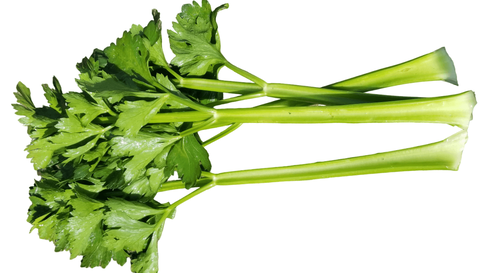
 Growing CeleryI always thought that growing celery (Apium graveolens) was difficult and required very moist conditions. However, there are now many varieties of celery, many of which are better adapted to drier growing conditions. One detail I learned after growing celery is that the bunches you buy at the store are the inner part of the plant. Celery also grows many outer ribs that are much narrower than the inner part of the celery. These outer ribs can be used just like regular celery, I like them in soups or stews, or I blanch and dehydrate them for celery powder. Favorite VarietiesCelery is one plant that I prefer hybrid varieties over open-pollinated. I have tried several open-pollinated but found they do not grow as well and are more bitter than the hybrid varieties I have tried. One caveat with this is that I have not tried blanching celery (keeping the stalks in the dark during the growing season and before harvest) which is supposed to keep it less bitter. One of the first hybrid varieties I tried was Tango and I had great success. It grew very well and is a faster-maturing variety at approximately 85 days. The next hybrid I tried is Kelvin and since I have grown that variety, it is the only one I have grown. It is like Tango, vigorous and low maintenance, but I feel it does better with hot temperatures (please note, I live in Wisconsin and my “hot” temperatures are nowhere close to what other parts of the country can hit) and lower moisture levels. It is also a faster-maturing variety at about 80 days. I use drip tape or soaker hoses connected to a timer throughout my garden, so this does help keep the soil evenly moist. Starting Celery From SeedCelery is one of the first seeds I start, about ten weeks before the average last frost date, due to its slow germination and subsequent slow growth. Celery seeds require light to germinate, so press them gently into your seed starting mix when starting seeds. A heat mat can help germinate the seeds if your grow room is cool, 70-75°F is ideal. After seeds germinate you can take them off the heat mat, so they are at about 60-70°F. I start fertilizing with an all-purpose liquid fertilizer once they start getting their true leaves with ¼ strength fertilizer. You can transplant them to a larger pot when they have at least 2 true leaves if you started them in smaller grow trays, I use 3.5” pots. Celery likes cooler weather, but cold temperatures can cause premature bolting so keep them above 45°F when hardening them off. I transplant into my garden about a week after my average last frost date. 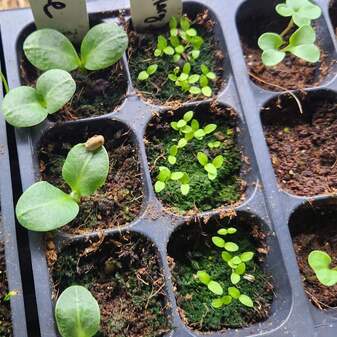 Tiny celery seedlings soon after germination (center row). Growing CeleryKeep celery mulched well to maximize moisture in the soil and keep weeds down. Using some form of irrigation on a timer is helpful to keep the soil consistently moist. Celery is a very heavy feeder so make sure your soil is healthy before planting. Compost or composted manure is a great addition to any soil. I also fertilize monthly throughout the growing season with a high-nitrogen fertilizer like blood meal or fish emulsion. Harvesting CeleryThe entire stalk (plant) of celery can be harvested whenever it is large enough for your use or alternative individual ribs can be removed and used as needed. I have found if I leave celery in the garden for the entire summer, plants often start bolting closer to fall. If you want to collect celery seed you can let some plants bolt, I find my growing season (zone 4b) is unfortunately too short to harvest seed. 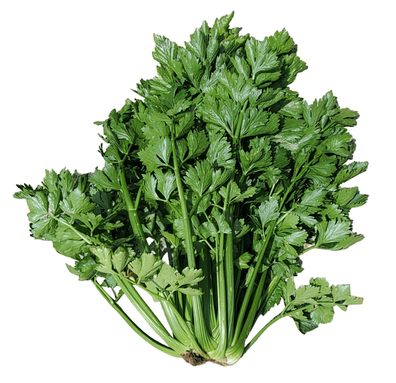 A monster celery I harvested that measured 30 inches tall! Celery DiseasesI have had some problems with celery that is misshapen and twisted with brown spots/streaks in the ribs. I have not had my celery tested for disease, but I believe it is either aster yellows, a disease caused by a phytoplasma, a bacteria-like organism, or leaf curl caused by anthracnose, a fungus. Aster yellows is transmitted by insects that feed on the plant so if you can control the insects, you can control the disease but once infected there is no way to treat the plant. Since I do not know whether I have a fungal disease or a phytoplasma disease, I choose to not treat my plants. Instead, when I find diseased plants, I pull them to prevent further spread, but I have never lost all my plants in a growing season. CautionVery rarely the foliage of celery and related plants (celeriac) can cause a reaction of the skin called photosensitivity or phytophotodermatitis. Compounds in celery, called psoralens, can cause blistering of the skin after the skin is exposed to sunlight. This is mostly seen in workers who harvest celery due to the extended amount of time they spend in contact with the vegetation. However, on sunny days it may be best to wear long sleeves and gloves when handling celery. ConclusionI highly recommend trying to grow celery in your garden. I was intimidated by growing celery because I thought it was something only commercial growers could reliably produce. But I find celery is one of the easier vegetables to grow in the garden and it has been a staple in my garden from the first year I tried it. References
0 Comments
Leave a Reply. |
AuthorIn 2016, my family and I moved from the New York City area to small town Wisconsin. Our move, this website and blog (and our previous Etsy store) is the result of our desire over the past several years to simplify our lives, increase our quality of life, reconnect with nature, and enjoy a more self-sufficient life. I grew up as a country kid in central Pennsylvania working on my grandfather's fruit farm and as a corn "de-tassler" at a local seed farm. My background is in biology where my love of nature originated. I am a former research scientist and professor and have now transitioned to a part-time stay-at-home mom, self-employed tutor, and small business owner. Thank you for taking the time to check out my site. Archives
July 2024
Categories
All
|
 RSS Feed